Friday, 12 June 2009
Sorry seems to be the easiest word...

Michael Portillo on 'This Week'
This is true, the BNP would never have won any seats in an election with the current Westminster system, but what he fails to understand is that it is this very same dismissive attitude concerning people's voting preferences that caused the situation in the first place. It seems that Mr Portillo does not wish to have a truly representative Parliament, rather a Parliament in which the working class concerns are ignored and marginalised.
The BNP should be revealed for what they really are, not a democratically elected party, but a fascist and racist grouping that only wish to return Britain to the dark ages in the name of ethnic purity. People like Mr Portillo, a politician of many years, should want to understand why nearly a million people voted for the BNP.
Maybe it is because these working class voters were never his core electorate, or it is easier to ignore them, but Mr Portillo is walking a fine line by ignoring the issues that surround this unprecedented event. Or maybe Mr Portillo would prefer a oligarchy, in which the power resides with the elite and the working classes do not have the vote, since he dislikes any form of representative Parliament.
Education and enfranchisement of these voters is needed, rather than the arrogance to ignore them.
Thursday, 11 June 2009
True Reform
Expenses
There is consensus that MPs must be adequately remunerated for the level of responsibility that is assumed. Here are a few thoughts on expenses reform:
- Every MP has a "grace and favour" 2 bedroom residence that is centrally located within easy distance of Westminster. This will be minimally furnished - no moats, no duck ponds and no mock Tudor beams. There will be no rent, but no expenses can be charged for accommodation. This would have the advantages that if maintenance needs to be carried out it can be done via a central contract and therefore, cheaper.
- The only expense that would be acceptable is travel to and from the constituency. The cost of this is paid at a standard class train or plane fare, if they wish to upgrade, then it is at their own expense.
- The MPs wage will increase to £75,000. Any future cost of living increase will be decided upon by an independent panel which will not be responsible to Parliament.
- No MP, whilst in office, can have any other form of employment that might compromise their role as a MP. Such examples can be found here. MPs are in Parliament to represent their constituents, not their interests.
- Staff (Parliamentary and constituency based) to be paid centrally.
- Tax-payers contributions to MPs' pension funds to be significantly reduced.
Parliamentary Reforms
Britain has probably the most archaic Parliamentary system in the western world, built on convention and precedence. Affectionately known as a elected dictatorship, the winning party in a general election commands the executive and the legislature, George W. Bush would have started Armageddon with this power. The second House is weak and ineffectual, filled with representatives of the current government. The situation demands reform:
- Reduce the number of MPs in the House of Commons, and have them elected via a form of proportional representation.
- Make the House of Lords wholly elected. This could be done via a number of different routes, maybe a more representative federal system. Furthermore, rebuke the Parliament Act which allows the House of Commons to completely overrule the Lords, if it does not endorse a Bill.
- MPs must have substantial links to the constituency that they represent. This will reduce the MP becoming the spokesman for the party in the constituency, rather than representing the constituency at a national level.
- Devolve power away from Westminster to a local level within certain parameters.
- Reduce the power of the party whip. This is probably wishful of all the points.
By instigating these reforms, Britain would become a more democratic country, with more people enfranchised. This is a true bicameral system that would build solutions on consensus and avoid landslides that allowed Britain to slip into war with Iraq.
Wednesday, 10 June 2009
Conservatives Announce Policies...
Sadly not, backtracking faster than Usain Bolt in a 100m sprint, the Conservatives said this was not a policy announcement, but a statement of Labour Party policy past 2011. It is approaching summer and the opening of the silly season, but this has to be one of the strangest exchanges of any Parliament.
- First Andrew Lansley claims it was Tory Party policy
- Then Gordon Brown attacks the Tories for destroying the NHS
- David Cameron retorts by claiming it is actually Labour Party policy
- Everyone starts pointing fingers claiming it is each others policy
- And Nick Clegg changes the subject completely
That is democracy in action...
However, it is easy for the public to believe that it could be both a Labour policy and a Tory policy; since neither party has clearly stated any official economic policies or public spending projections for the next five years. This policy could well be the policy of both parties, but with the public still reeling from the MPs' expenses scandal neither Gordon Brown nor David Cameron wish to tell the public how bad things are going to be.
It is going to be a fun summer; playing policy hot potato...
Even Birds do not like Bankers.
Carpe Diem, Mr Brown.
"In the midst of all the rancour and recrimination, let us seize the moment to lift our politics to a higher standard."This speech had more in common with Dead Poets Society than a serious attempt reform the electoral system in Britain. Although it will be a long time before his fellow Labour MPs will stand up in support of their "Captain! My Captain!"
Excuse the cynicism, but this has all been said before. It is a pantomime performance that every time a government is in danger of losing a forthcoming election, it changes its rhetoric to a populist tagline. How many times in the past eighteen years has a Prime Minister or Leader of the Opposition promised to "clean up" British politics. If they were true to their word perhaps now there would be a workable system in place.
However, amongst the predictable rhetoric from both sides of the House, there is potential for significant and actual change in the British political culture, which could usher in a new dawn of transparency and accountability. There also needs to an important discussion concerning the disenfranchisement of great swathes of the electorate.
Soon it will be time to judge Gordon Brown on his actions, not just his words... Carpe Diem, indeed.
Tuesday, 9 June 2009
The Most Surprising Result.
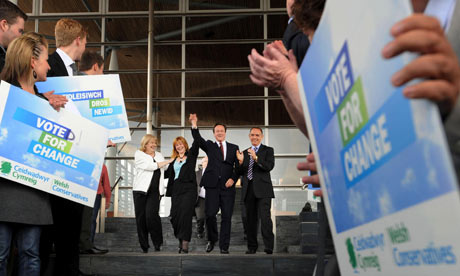 David Cameron appeared in the Welsh National Assembly yesterday, with all the pomp and circumstance of Rocky Balboa standing aloft the steps of Philadelphia City Hall. Whether it was the Labour vote staying home or the electorate genuinely voting Conservative, the shock waves of this result will resonate for sometime.
This, more than the BNP winning two MEP seats in the North of England, was the most surprising result of Sunday's EU election. Wales has been a stronghold for the Labour Party for nearly a hundred years, even during the dark days of 1979 and 1983, there was always a light on in Wales for the Labour Party. If Gordon Brown and the Labour Party can lose to the Conservatives in Wales then no constituency and MP is safe.
According to Dante there are seven deadly sins; Gluttony, Greed, Sloth, Envy, Pride, Lust and Labour losing Wales to the Conservative Party. It is probably a natural progression, the Labour Party had committed the six other deadly sins during the MPs' expenses scandal, so losing Wales was the complete set.
Friday, 5 June 2009
Same Old, Same Old.
Now that the dust is settling after a hectic 24 hours in
There are two obvious reasons for the new (old) look cabinet:
- Gordon Brown has either embraced the status quo, keeping most of the ministers in their original departments, for the sake of consistency.
- Or he has no choice left. The ministers have wrestled the power from the Prime Minister and are now calling the shots.
Furthermore, Mr Brown has attempted to gloss over is impudence by attempting to distract everyone with some left field appointments; Lord Sugar (Lord help us more like) and Glenys Kinnock (this appointment no one saw coming). These "celebrity" appointments have shown that the talent in the current PLP either do not want to work in Gordon Brown's Government or simply just does not exist.
Hopefully the Prime Minister avoided the temptation to call Susan Boyle and Davina McCall...
The New (Old?) Cabinet
Prime Minister: Gordon Brown
Leader of the Commons: Harriet Harman
First secretary of state: Lord Mandelson
Chancellor of the exchequer: Alistair Darling
Foreign secretary: David Miliband
Justice secretary: Jack Straw
Home secretary: Alan Johnson
Environment, food and rural affairs secretary: Hilary Benn
International development secretary: Douglas Alexander
Communities and local government secretary: John Denham
Children, schools and families secretary: Ed Balls
Energy and climate change secretary: Ed Miliband
Health secretary: Andy Burnham
Northern Ireland secretary: Shaun Woodward
Leader of the Lords: Lord Royall of Blaisdon
Minister for the Cabinet Office, the Olympics and paymaster general: Tessa Jowell
Scotland secretary: Jim Murphy
Work and pensions secretary: Yvette Cooper
Chief secretary to the Treasury: Liam Byrne
Wales secretary: Peter Hain
Defence secretary: Bob Ainsworth
Transport secretary: Lord Adonis
Culture, media and sport secretary: Ben Bradshaw
"Reform, Reform, Reform"
Thirteen years on, Gordon Brown needs a similar tactic, if he is to survive the dire local and EU election results. There is no yardstick currently available to most of the general public to measure his performance by; only the prophetic cries of "we are fixing the economy." The issue with this as a measuring instrument is twofold;
- If public are to believe Mr Brown, that the UK could not effect the recession since it was a global phenomenon, how is the general public supposed to know that the relief packages designed by the government are alleviating the problem. It could just be an upturn in world markets.
- Secondly, many people believe that Gordon Brown's policy of deregulation for the banks, in many ways exacerbated the issue in the first place.
By setting out a clear bill of reforms for the House of Commons, MPs' expenses and the House of Lords, Gordon Brown will then be able to be judged on a definable set of criteria.
However, it is doubtful that he will use the mantra of "reform, reform, reform."
Where was Gordon's Mandate?
"There is now a wide coalition of MPs from all wings of the Labour Party who are sadly convinced that a change of leadership in now unavoidable. It is hoped that Gordon will accept the will of the PLP and agree to a swift orderly exit."
But Mr Flynn thinks that Gordon Brown has been unfairly maligned by the Press and the public for the expenses scandal. However, what Paul Flynn fails to recognise or completely ignores is that Gordon Brown is perceived to have no mandate from the general electorate. In the public eyes Gordon Brown usurped the democratically elected Prime Minister with no legitimacy; it was a succession rather than a justification of the democratic process.
If Gordon Brown had gone to the public in October 2007 and called for a general election, he would currently be in a better situation with a justifiable mandate to govern. However, there is no mandate from the public, many people are feeling disenfranchised by the whole process. The Government have pursued policies that detach themselves from the electorate; ID cards etc. This is the main reason the public and press have turned on Gordon Brown, in a Parliament where there seems little in the way of accountability the expenses scandal was the straw that broke the camels back.
If the Labour Party choose to follow a path of electing another leader without the promise of a general election shortly afterwards, the feelings of disenfranchisement amongst the public will continually increase.
Thursday, 4 June 2009
A Defining Speech by a Remarkable Man.
However, considering President Obama's nuanced approach during his speech, many media outlets have dubbed the speech as 'America and the Muslim world'. During the speech Barack Obama was at pains to differentiate the different Muslim groups from one another, and talked at great length about respecting and treating each group differently. But the main news rooms, CNN, Fox and BBC, have ignored this important nuance.
Whether the speech has been truncated in to digestible soundbites for the perceived ease of their audience or the journalists are still trapped in the language of the previous administration, this has yet to be seen. But to ignore the finer points has done the speech and Barack Obama a great disservice.
Sadly Jeremy Bowen urged caution; stating that by giving hope for a peaceful resolution for many of the conflicts around the world, Barack Obama has set himself up to disappoint many people. But surely by stating that he recognises that a more nuanced approach is necessary, President Obama is developing good will and political capital that can potentially be used to reach compromises in certain conflicts. Something that his predecessor certainly lacked.
The Political Whodunnit...
 Which one of these mild manner senior Labour party officials (and John Cruddas) will stab Gordon Brown in the back first?
Clue: It is not John Cruddas.
Wednesday, 3 June 2009
Rebel's Timetable
"Here's how events could pan out, according to the rebels:
4 June: Local and European election polling day.
5 June: Results from local elections; pressure mounts on Brown.
7 June: European election results expose the full scale of the electoral defeat suffered by Brown.
9 June: The prime minister is forced from office.
10 June: Labour's ruling national executive committee would meet and a new timetable would be announced.
The rebels have told the Guardian they think, and some senior trade union officials have even suggested to them, that the trade union involvement could be cut out altogether.
The advice of the three officials has assured the rebels that their shortened schedule would be "waterproofed" against legal challenge by the prime minister.
11 June: The parliamentary Labour party would meet and nominate their chosen new leader on the Thursday
12 June: Nominations for leader close.
16 June: Leadership ballot papers are distributed.
29 June: Selection of the new leader at a special conference held by the Labour party
2 July: Brown would formally resign and the new prime minister would be installed.
8 July: First prime minister's questions for the new leader
21 July Parliament breaks for the summer recess."
It seems fanciful that this timetable could be stuck to. It also conveniently forgets the political pressure from the general public, being rightly annoyed by having another unelected Prime Minister.


 Posts
Posts

